
Ai generated image
Branded packaging is an important part of a company's identity. Whether it's a paper bag, gift box, paper cup or other customized packaging, a logo helps make a brand recognizable.
But did you know that adding a company logo to packaging can also change who is responsible for its compliance?
In April, we introduced the EU Packaging and Packaging Waste Regulation (PPWR). Since August 12th, 2026, the first requirements have applied, including restrictions on substances in packaging and obligations concerning technical documentation and EU Declarations of Conformity.
When do the PPWR requirements apply?
PPWR requirements are being introduced gradually over the coming years.
What does this mean today?
Since August 2026, companies must comply with the applicable substance restrictions and ensure that the required conformity documentation is available.
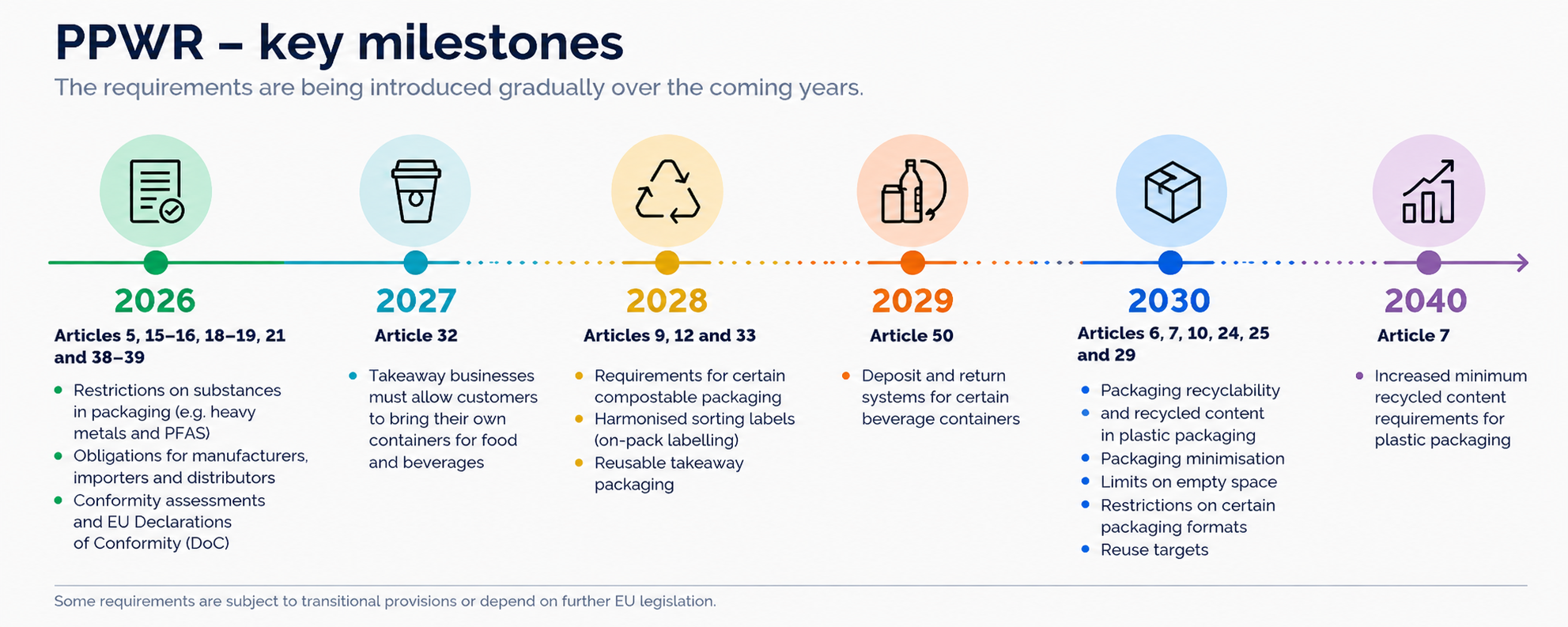
Some requirements are subject to transitional provisions or further EU legislation. Illustration made with AI.
Packaging ownership and resposibility
Does a logo make a company the manufacturer of packaging?
Under PPWR, when packaging is designed or manufactured under a company's name or trademark, that company is considered the manufacturer, even if it is sourced through Metz and produced by an external supplier.
This means the company must ensure compliance with PPWR and that the necessary documentation is available.
The good news! Companies do not have to manage the entire documentation process alone.
Who is responsible for the packaging?
Under PPWR, responsibility depends on who has the packaging manufactured, whose name or trademark it carries, and where it is sourced.
A logo on the product alone does not make the company the manufacturer of standard, unbranded packaging. However, when packaging is specially manufactured under the company´s name or trademark, the company is generally considered the manufacturer.
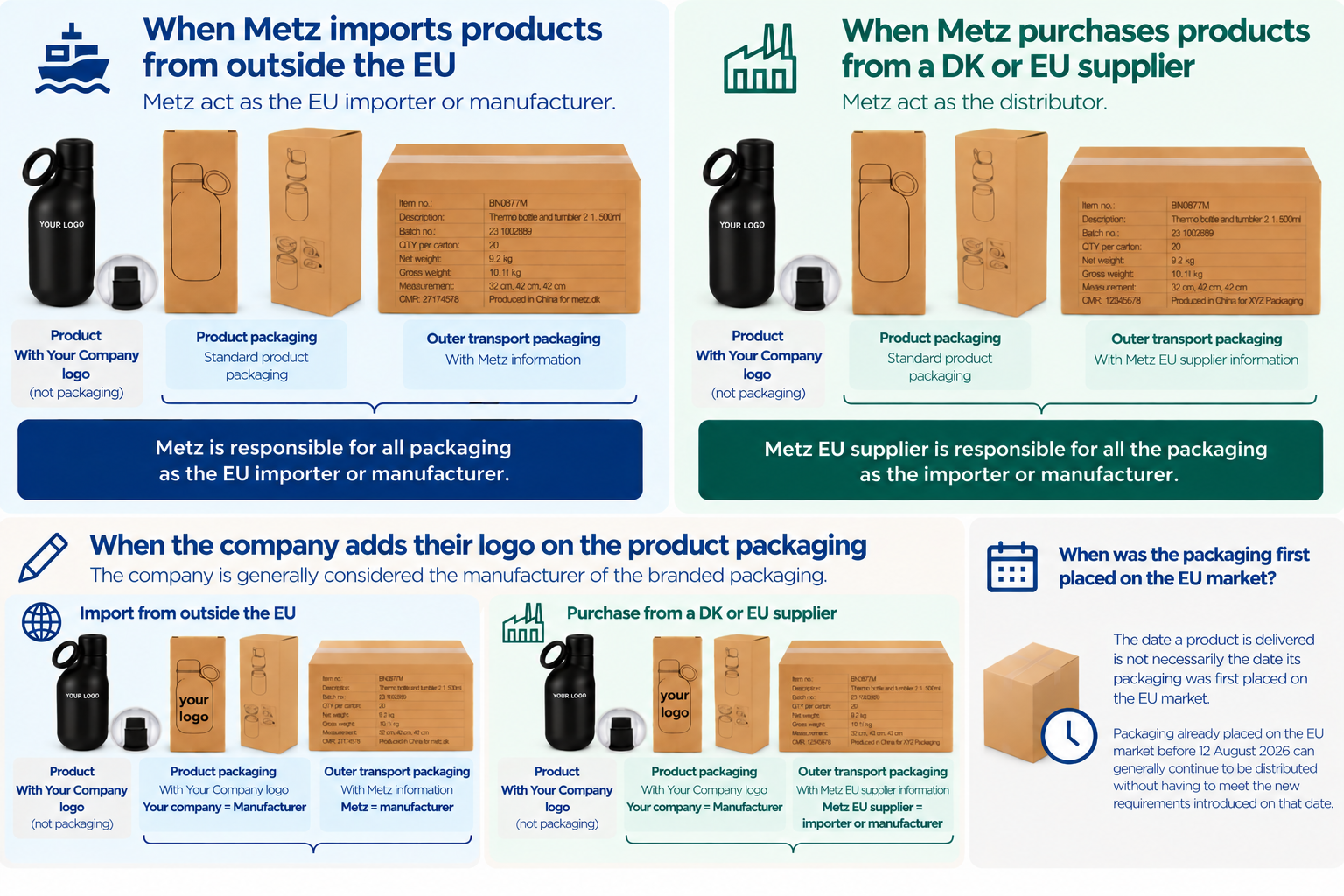
Illustration made with AI
PPWR defines different obligations for each role in the supply chain:
Suppliers: Provide manufacturers with the information and documentation needed to demonstrate compliance.
Manufacturers: Ensure packaging complies with PPWR, carry out the conformity assessment and prepare the EU Declaration of Conformity (DoC).
Importers: Are responsible for ensuring that packaging imported from outside the EU complies with PPWR and that an EU Declaration of Conformity (DoC) has been prepared. The importer holds responsibility for fulfilling the applicable importer obligations on the EU market and cannot transfer these obligations to a manufacturer outside the EU.
Distributors: Verify that the relevant manufacturer and importer obligations have been fulfilled before making packaging available on the market.
What documentation should be requested?
The documentation required under PPWR depends on the company's role in the supply chain.
When acting as a supplier
Suppliers of packaging or packaging materials must provide manufacturers with the information and documentation necessary to demonstrate compliance with PPWR.
Relevant documentation includes:
Material specifications: Information on packaging composition, including inks, coatings and additives where relevant.
Article 5 compliance: Information demonstrating compliance with applicable substance restrictions.
Supporting documentation: Supplier declarations, assessments and relevant test reports.
Traceability: Information identifying the supplied packaging or materials.
When acting as a manufacturer or importer
Manufacturers must ensure that the packaging complies with PPWR and that the necessary technical documentation supports the EU Declaration of Conformity (DoC). Importers must verify compliance and ensure that the required documentation is available.
Relevant documentation includes:
Material specifications: Packaging composition, including inks and coatings where relevant.
Article 5 compliance: Evidence of compliance with applicable substance restrictions.
Supporting documentation: Supplier declarations, assessments and relevant test reports.
Technical documentation: Information required under Annex VII to demonstrate conformity.
Traceability: Information linking the packaging to its documentation.
When acting as a distributor
Distributors are not generally required to prepare the technical documentation or issue the DoC. However, they must verify that the applicable manufacturer and importer obligations have been fulfilled.
Relevant documentation and information to request include:
EU Declaration of Conformity (DoC): Confirmation that a valid declaration has been prepared by the responsible manufacturer.
Manufacturer and importer information: Identification of the responsible economic operators.
Traceability: Information linking the packaging to the relevant declaration and supplier.
If there is reason to believe that packaging does not comply with PPWR, it must not be made available on the market until compliance has been ensured.
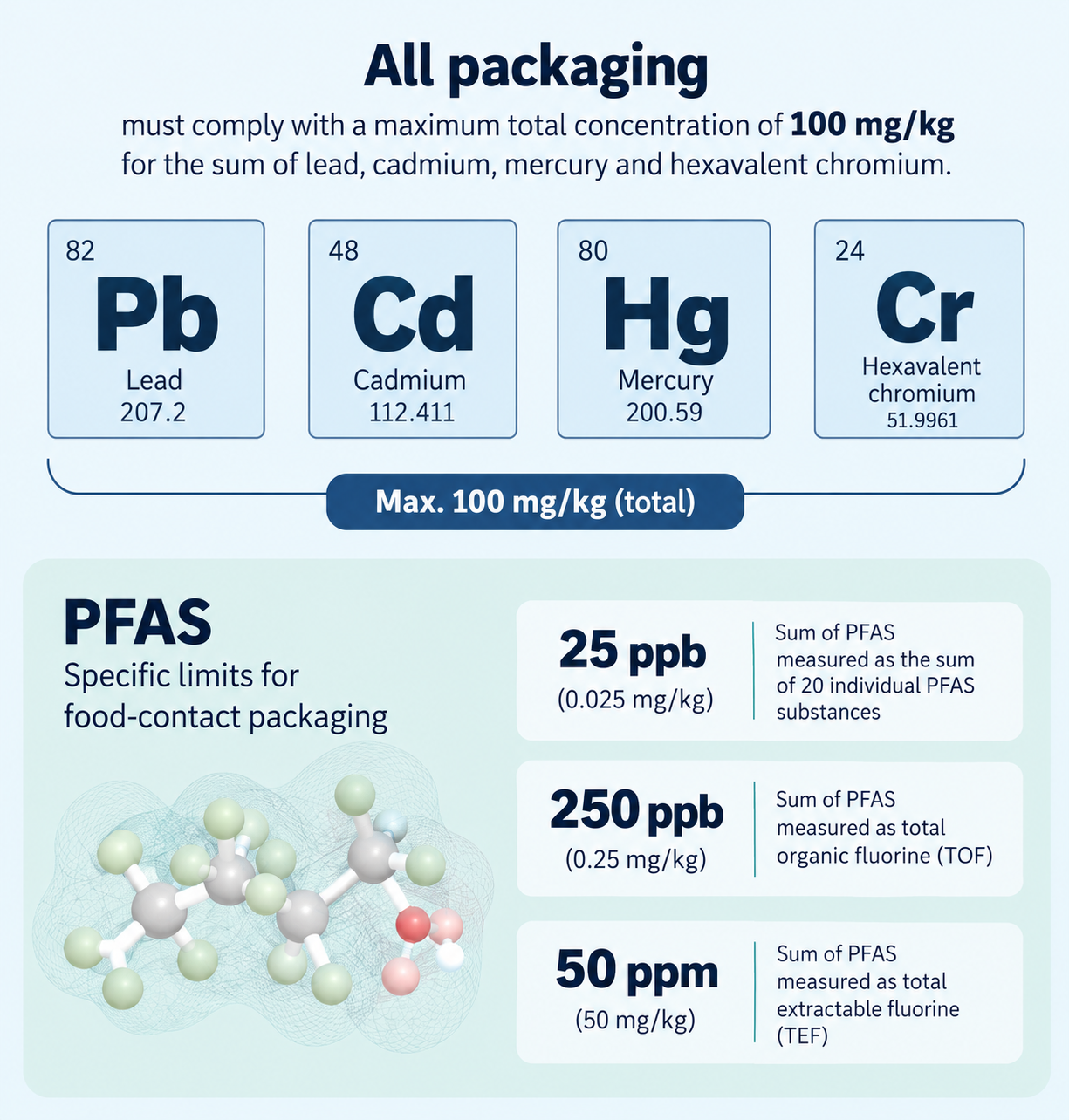
Illustration made with AI
What does Article 5 actually mean?
Article 5 restricts substances of concern in packaging.
For all packaging, the combined concentration of lead, cadmium, mercury and hexavalent chromium must not exceed 100 mg/kg.
Food-contact packaging must also meet specific PFAS restrictions, with limits of 25 ppb, 250 ppb and 50 ppm, depending on how the substances are measured.
How do we support you?
At Metz, we believe branding and compliance go hand in hand.
We work with our suppliers to obtain and review the necessary technical documentation, helping customers meet the relevant PPWR requirements.
When customers have the manufacturer's responsibility, we provide relevant supplier documentation to support their EU Declaration of Conformity and offer advice and guidance, including assistance with preparing the declaration if needed.
This allows customers to focus on their branding, while Metz helps ensure that the necessary compliance documentation is available.
Want to know more?
Read our previous blog about PPWR: EU Packaging and Packaging Waste Regulation.
For further information, explore the official EU Packaging and Packaging Waste Regulation (EU) 2025/40 or the Danish Environmental Protection Agency's guidance on packaging (in Danish).