Green marketing rules: From preparation to practice

Ai generated image
On September 27th 2026, new rules on environmental marketing entered into force in Denmark.
Earlier this year, we wrote about greenwashing and some of the new requirements companies needed to prepare for. Back then, the deadline was still months away.
The new rules are no longer on the horizon. They're here.
Also in September, the Danish Consumer Ombudsman published revised recommendations with updated guidance and practical examples.
So rather than repeating what the rules say (click here to see previous blog on greenwashing), we want to focus on what companies should be paying attention to now.
1. Look at the communication already out there
The new rules are not only relevant to new products and campaigns. They also apply to products and packaging produced before September 27th 2026.
European consumer authorities have published a common understanding on how the rules should be enforced for products already on the market. But the key message is simple:
Don’t just review your future marketing. Take a look at what is already out there.
That includes everything from product pages, webshops and packaging to catalogues, sales materials, icons and badges.
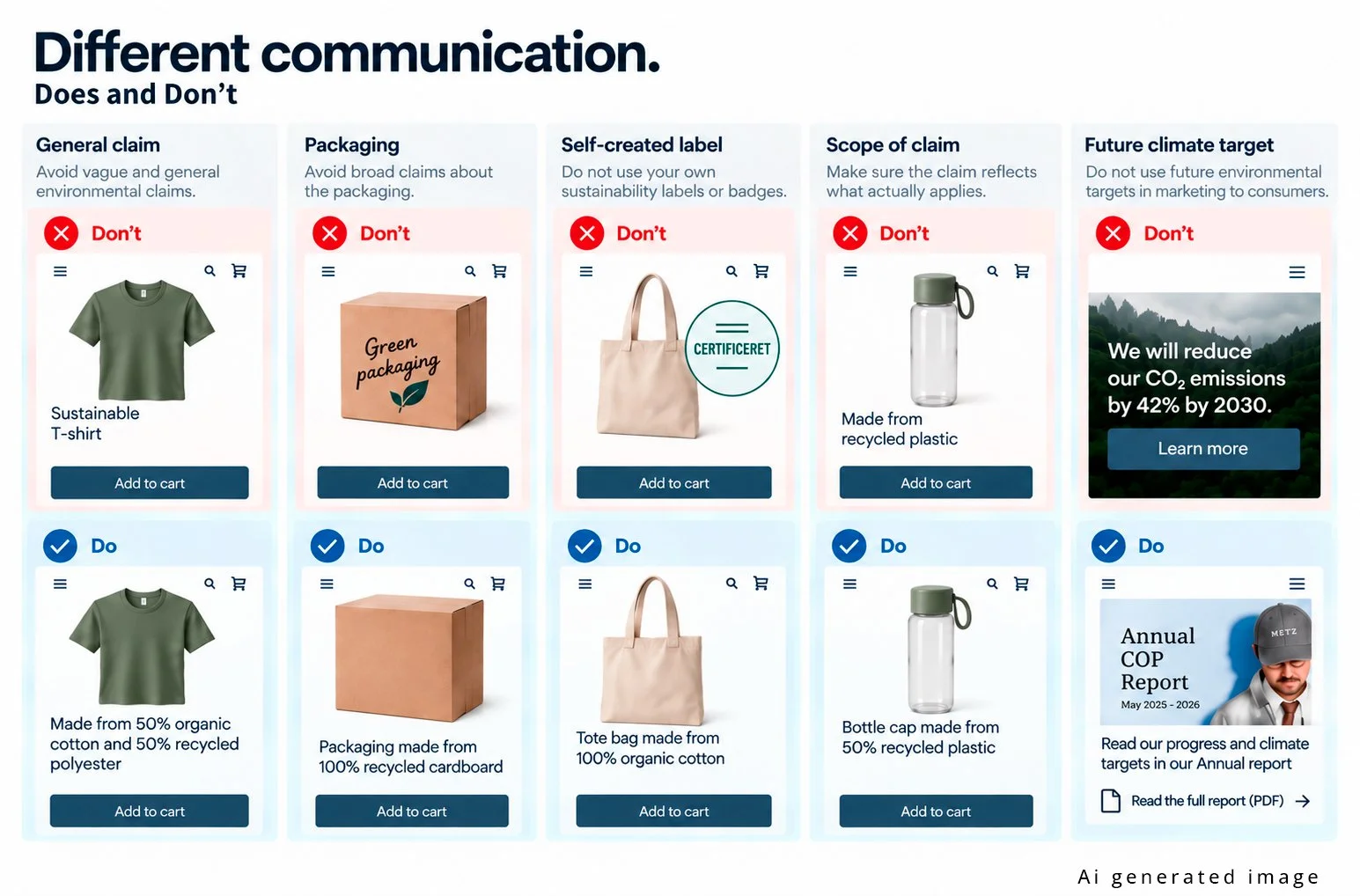
Documentation is only the starting point
Having documentation for a fact does not automatically mean that it can be communicated in any way.
Even factually correct information may be misleading depending on how it is presented and the overall impression it creates.
How the information is communicated matters too.
Same product. Different communication.
Small differences in wording, scope or visual presentation can significantly change the message the customer receives.
The examples to the right 👉🏼 illustrate a simple point: Scope, context and presentation matter.
Want to see more examples?
See Annex I of the Danish Consumer Ombudsman’s recommendations (from p. 52) for practical examples of lawful and misleading environmental claims, including how claims are presented on products and in online marketing.
2. Changing the word does not solve the problem
Replacing a broad term such as “sustainable” with another expression is not the solution.
The same goes for visual communication: A badge, leaf, recycling symbol or other visual element can also influence how customers perceive a product’s environmental impact.
From September 27th, displaying a sustainability label that is not based on a certification scheme or established by a public authority is considered misleading.
The answer is therefore not to find another environmental word or symbol.
Communicate the underlying fact
What material is used? What percentage is recycled? What exactly is certified? And does the information apply to the whole product or only part of it?
It’s not just about what you say, but also about providing the right information.
Read more: Danish Consumer Ombudsman’s recommendations, Section 4 (pp. 20–21), Section 6 (pp. 27–34) and Section 9 (pp. 46–48).
3. ESG reporting and environmental marketing are not the same thing
Many companies publish climate targets as part of their ESG strategy and reporting.
But reporting a target and using it as an environmental marketing claim are not the same thing.
Claims about future environmental performance are subject to specific requirements. They must be supported by clear, objective, publicly available and verifiable commitments, and a detailed and realistic implementation plan with measurable and time-bound targets. The plan must also be regularly verified by an independent third-party expert, whose conclusions must be made available to consumers.
So before moving a 2030 target from an ESG report onto a homepage, product page or campaign, consider the context in which it is being communicated and the impression it creates.
Read more: Danish Consumer Ombudsman’s recommendations, Section 10.2 (pp. 49–50).

Ai generated image
4. Make communication a compliance question
Claims may appear in marketing, but the information behind them often comes from purchasing, suppliers, certifications, product compliance, or ESG data.
That makes internal cooperation important.
At Metz, we ask ourselves four simple questions before publishing an environmental message:
Is the underlying fact documented?
Does the claim cover exactly what the documentation covers?
Could the wording or visual presentation create a broader impression?
Would the customer understand the message in the way we intend it?
Because having documentation behind a fact is only part of the assessment.
The way the fact is communicated matters too.
Read more: Danish Consumer Ombudsman’s recommendations, Sections 2.1-2.2 (pp. 6–15).
From preparation to practice
When we wrote about greenwashing earlier this year, companies still had time to prepare.
Now we have moved from preparation to practice.
The Danish Consumer Ombudsman's revised recommendations provide updated guidance and practical examples covering areas such as documentation, environmental claims, greenhouse gas reductions, sustainability labels and future environmental performance.
Read more here: Forbrugerombudsmandens anbefalinger til virksomheders miljømarkedsføring
And perhaps the most useful question has also changed.
It is no longer only:
“Can we document it?”
It is also:
“Are we communicating exactly what we can document?”
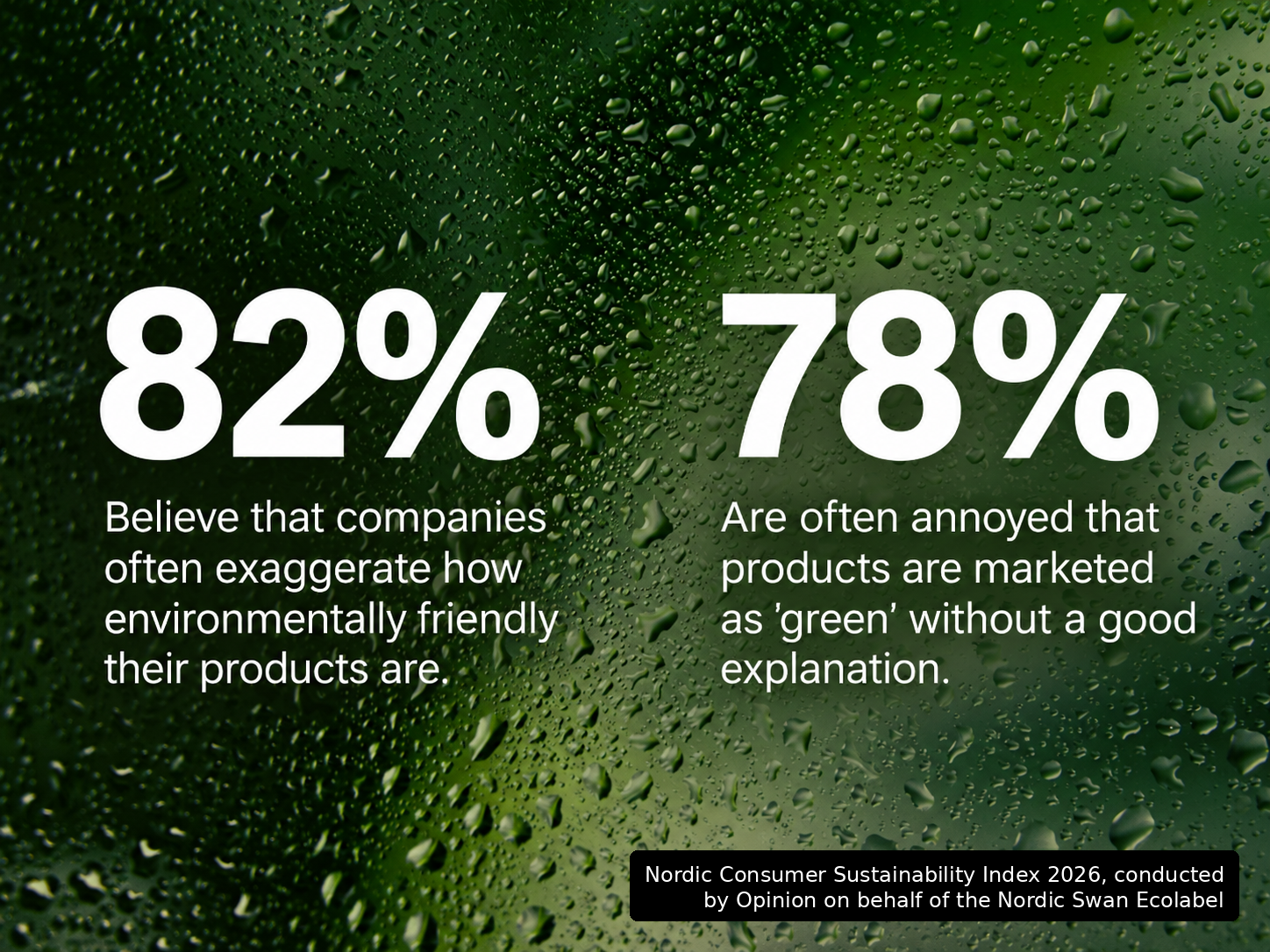
Nordic Consumer Sustainability Index 2026, conducted by Opinion on Behalf of the Nordic Swan Ecolab